Atheism as the Ultimate Monotheism: A Philosophical Inquiry into Language, Symbols, and Divine Perception
I. Introduction: Socrates’ True Challenge
In a recent philosophical salon discussing Stoicism, a speaker offered a provocative reinterpretation of Socrates’ trial: the philosopher was not challenging the gods themselves, but rather the politicians who wielded divine authority as a tool of control. This distinction illuminates a fundamental tension that persists today — between authentic spiritual experience and its institutional appropriation.
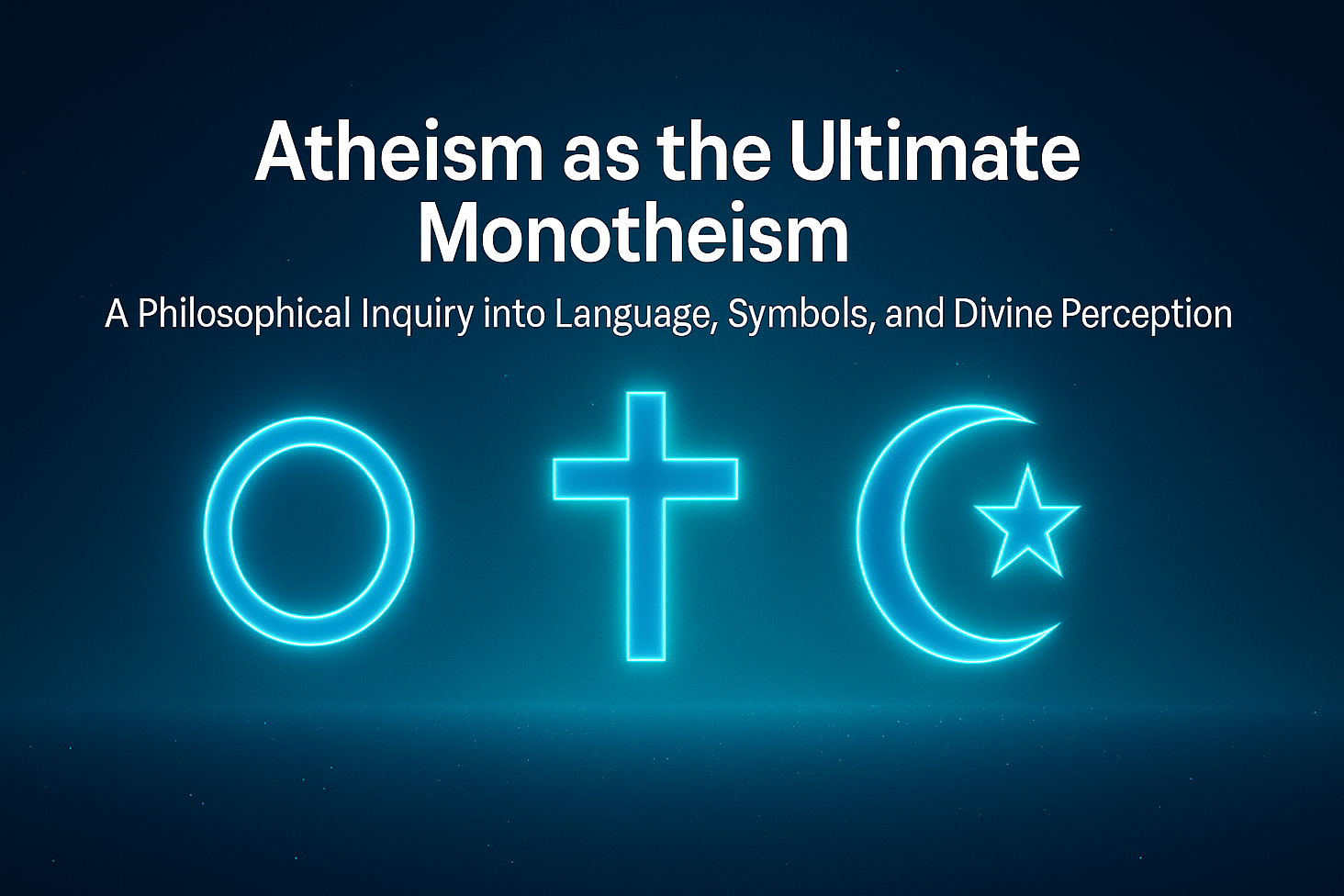
This paper proposes a radical reconceptualization of the monotheism-atheism dichotomy. Drawing on Wittgensteinian language theory, comparative religious studies, and phenomenological analysis, I argue that atheism represents not the negation of monotheism but its ultimate expression — a belief system so absolute in its singularity that it admits no variation or exception.
II. The Linguistic Construction of Divinity
Wittgenstein’s insight that human language operates as a system of symbols provides a crucial framework for understanding religious diversity. Consider the evolution of human expression of the numinous:
Visual symbols → Cave paintings depicting supernatural forces
Sounds → Ritualistic chants and sacred utterances
Lyrics → Structured hymns and prayers
Language → Theological discourse and scripture
This progression reveals how humans across cultures have attempted to capture and communicate their encounters with what Rudolf Otto termed the “mysterium tremendum.” The Tetragrammaton (YHWH) in Judaism exemplifies this process — a name considered too sacred to pronounce, pointing to the inadequacy of language to fully contain divine essence.
Similarly, the 99 names of Allah in Islam represent an attempt to approach the ineffable through linguistic multiplication, while Hindu traditions embrace thousands of names for the divine, acknowledging that no single designation can encompass ultimate reality.
III. The Paradox of Monotheistic Plurality
The Abrahamic traditions offer compelling evidence for the thesis that monotheism inherently contains multitude. Consider these linguistic variations of the same prophetic figure:
Abraham (English/Christian tradition)
Ibrahim (Arabic/Islamic tradition)
Avraham (Hebrew/Jewish tradition)
These are not different individuals but varied phonetic representations of a single historical-mythical figure. The story of Abraham’s two sons — Isaac and Ishmael — further illustrates how a unified narrative source branches into distinct religious traditions, each claiming exclusive access to divine truth while drawing from the same wellspring.
The phenomenon extends beyond names. The angel Gabriel/Jibril/Gavriel announces divine messages across traditions, yet each community interprets these communications through its unique linguistic and cultural lens. This suggests that what we call “different religions” may be better understood as diverse symbolic systems attempting to articulate a common human experience of transcendence.
IV. The Anthropomorphization Process
The transformation of ineffable spiritual experience into comprehensible human categories follows a predictable pattern:
Encounter: Humans experience inexplicable power or presence
Personification: This force is given human-like attributes
Naming: The personified deity receives culturally-specific designation
Visualization: Physical representations emerge (despite prohibitions)
Institutionalization: Organized structures codify the experience
The Greek pantheon demonstrates this process explicitly — natural forces (thunder, sea, harvest) become personified as Zeus, Poseidon, and Demeter. Even supposedly aniconic traditions struggle with anthropomorphism: Christianity’s incarnation doctrine literally embodies divinity in human form, while Islam’s hadith literature attributes remarkably human emotions to Allah.
V. Redefining Monotheism Through Relativistic Perspective
If we accept that religious diversity represents varied human responses to a singular transcendent reality, then monotheism itself becomes paradoxical. The insistence that “my one God is the only true God” multiplies the divine rather than unifying it.
Consider the Council of Nicaea (325 CE), where Christian bishops debated Christ’s nature. The resulting Trinitarian doctrine — three persons in one God — illustrates how monotheism tends toward internal multiplication. Similarly, Sufi mysticism’s concept of wahdat al-wujud (unity of existence) suggests that apparent multiplicity masks underlying unity.
From this perspective, polytheism appears more honest about divine plurality, while monotheism maintains unity through cognitive dissonance. The Hindu concept of Brahman — ultimate reality manifesting through countless deities — may offer a more coherent model than rigid monotheistic exclusivism.
VI. Atheism as Absolute Monotheism
Here we arrive at the paper’s central paradox: atheism represents the purest form of monotheism. Consider the logical structure:
Traditional Monotheism: “There is only one God (and it is mine)”
Admits multiple claimants to divine status
Requires constant rejection of alternatives
Maintains openness to variation and interpretation
Atheism: “I believe in no gods”
Admits exactly one possibility: non-existence
Requires no comparative theology
Maintains absolute closure to alternatives
The atheist’s “I do not believe” becomes the only belief, elevated to supreme status. This is not mere absence but active presence — a faith so total it excludes all competition. Nietzsche’s “God is dead” functions not as negation but as the birth of a new absolute: the supremacy of non-belief.
Furthermore, when atheists declare “I believe only in myself” or “I believe only in reason,” they establish a monotheistic structure more rigid than any traditional religion. The self or reason becomes the sole object of faith, brooking no rivals or alternatives.
VII. Conclusion: Transcending Binary Thinking
This analysis reveals the inadequacy of conventional religion/irreligion binaries. If atheism is ultimate monotheism, and monotheism contains inherent plurality, then our categorical frameworks require fundamental revision.
The implications extend beyond academic philosophy:
For interfaith dialogue: Recognition that differences may be largely linguistic rather than substantive
For secular-religious relations: Atheists and believers share more structural similarities than either typically acknowledges
For individual seekers: Freedom to explore spirituality without categorical constraints
The speaker at the philosophical salon was correct — Socrates challenged not the gods but those who claimed to speak for them. In our age, perhaps the greatest challenge is recognizing that our linguistic categories — theist, atheist, monotheist, polytheist — may obscure more than they reveal about humanity’s relationship with transcendence.
Whether one declares “God is one,” “Gods are many,” or “There are no gods,” each statement represents an attempt to capture infinity in finite language. The ultimate irony may be that in our very attempts to define and confine the divine — or its absence — we demonstrate the inadequacy of human concepts to contain that which, by definition, exceeds all containment.
“Atheism is the greatest monotheism”— in this provocative formulation lies both paradox and profound truth, challenging us to think beyond inherited categories toward a more nuanced understanding of belief, unbelief, and the mysterious territory between them.
Published on Medium: August 8th, 2025.